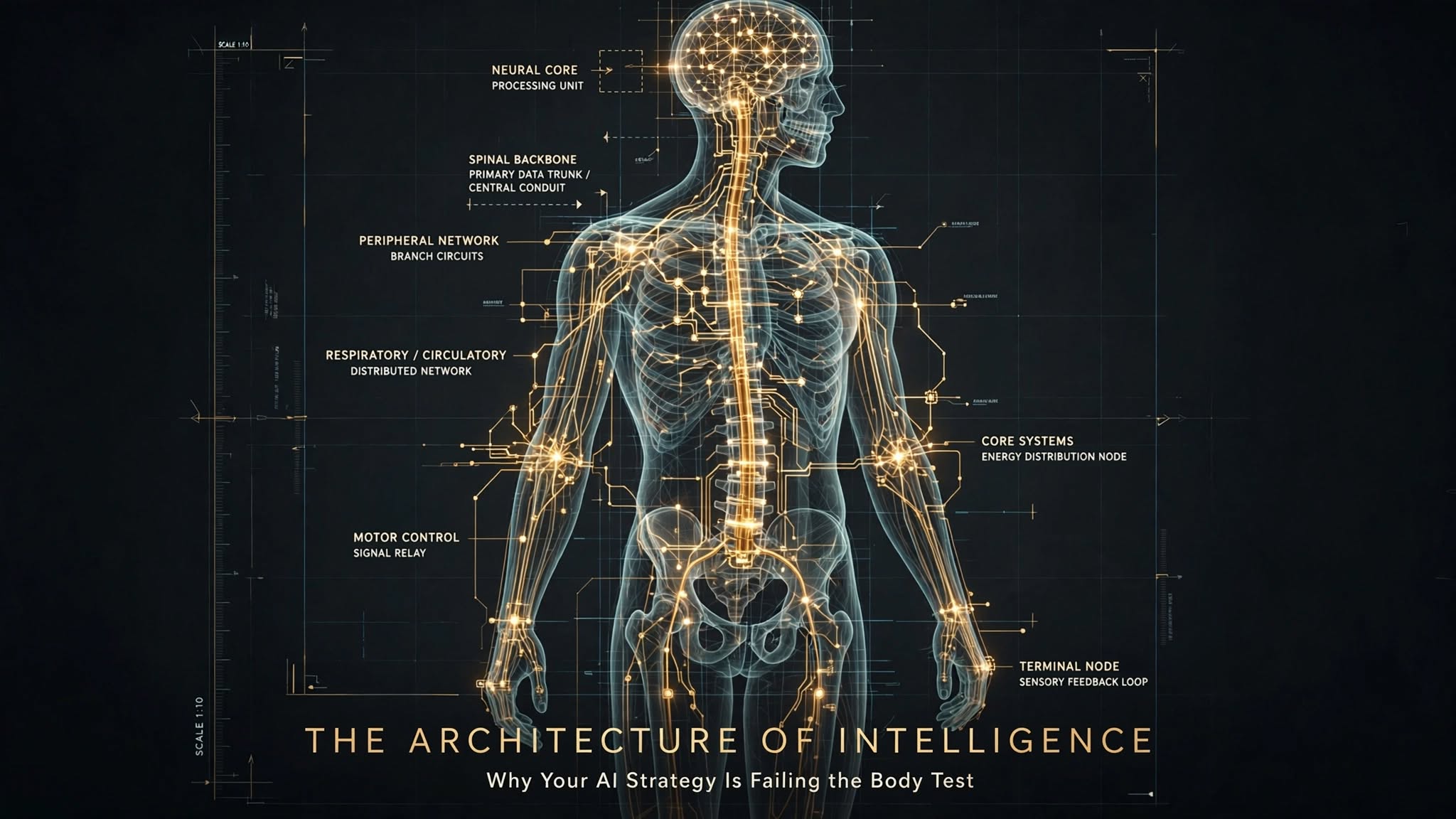
The Architecture of Intelligence: Why Your AI Strategy Is Failing the Body Test
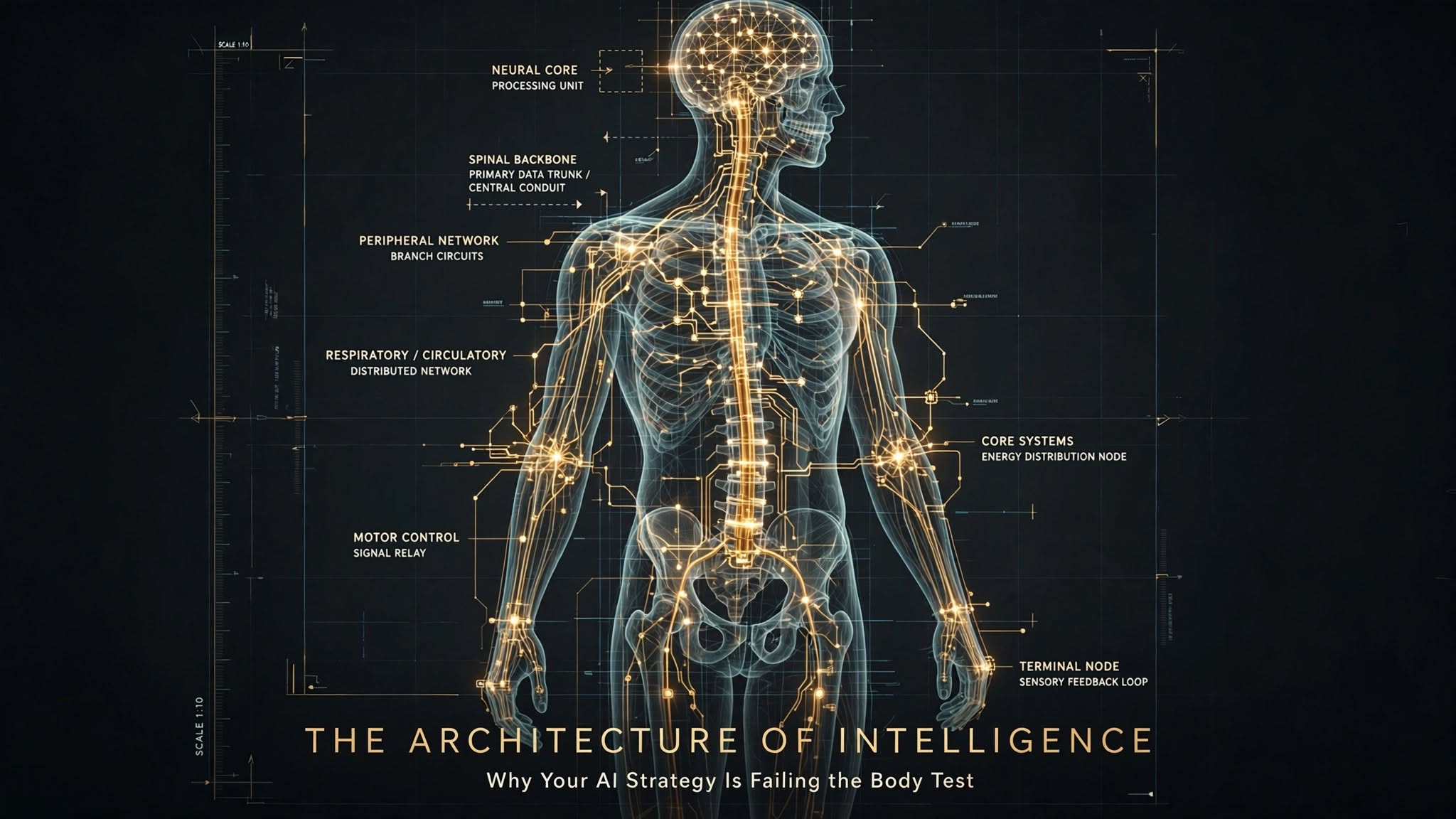
How LLMs, RAG, MCP, and Agents fit together — and why treating them as interchangeable is a strategic misstep, not a technical one.
Strategic Framing
Most confusion about AI inside growing organizations isn't a confusion about intelligence. It's a confusion about architecture.
I hear the same question in a dozen different forms every week: Do we need an LLM? Do we need RAG? Should we build "an agent"? What about this new protocol everyone's talking about? The question itself reveals the strategic error — it treats layers of one system as if they were competing products on a shelf. They are not rivals. They are dependencies.
A simple analogy makes this visible: an AI system behaves like a human body. Used loosely, that's a slogan. Used structurally, it becomes a design rule — and design rules are the difference between an organization that deploys AI and one that architects it.
This is the distinction most companies miss, and it's costing them more than a bad integration. It's costing them the credibility of every AI initiative they attach their name to.

The Four-Layer Anatomy of an AI System
1. LLM — The Brain
A large language model understands and generates language. It recognizes patterns. It reasons through tasks. It is the core intelligence layer of the system.
What it is not: a filing cabinet, a live database, or a pair of hands.
An LLM answers from what was compressed into its weights during training. That knowledge has a cutoff — it cannot see your contracts, your CRM, last week's policy memo, or the file that changed this morning, unless you deliberately put that material in front of it. And here is the strategic risk most leaders underweight: an LLM can sound certain while being wrong. Certainty is a style. Grounding is a system. Confuse the two, and you've built a confidence engine, not a decision engine.
If you stop at the brain, you get fluency without accountability.
2. RAG — The Brain Plus the Books
Retrieval-Augmented Generation doesn't replace the model. It gives the model something to actually read before it speaks.
When a question arrives, the system retrieves relevant passages from your documents, your databases, or your search index, then hands that material to the model as context — so the answer comes from the record, not from memory. That's the strategic shift: from "what do you remember?" to "what does the record say?"
RAG is how a leader:
Keeps answers current without retraining the model
Uses proprietary knowledge without exposing it into model weights
Reduces hallucination by constraining generation to retrieved, sourced text
Cites the source instead of performing omniscience
RAG is still only reading. It finds and it frames. It does not file the report, update the ticket, or execute the transaction.
3. MCP — The Standard Connector
MCP — Model Context Protocol — is the nervous system of the architecture. It is not a smarter brain. It's a common way for AI applications to attach to tools and data — APIs, databases, files, services — through one protocol instead of a pile of one-off integrations built by whoever was available that quarter.
Without a connector standard, every tool is a custom nerve, wired by hand. It works — until the next integration arrives, and the whole system frays at the seam.
With a shared protocol, the brain can reach further into the organization without a new invention every time. That's infrastructure. Not magic — architecture.
4. Agent — The Brain Plus the Hands
An agent decides what steps to take. It draws on knowledge, tools, and workflows. It doesn't just answer — it acts.
This is the leap most teams underestimate, because answering is cheap and acting creates consequence: a sent email, a changed record, a triggered workflow, a decision other people will have to live with.
An agent without retrieval is a confident actor with a poor brief.
An agent without connectors is a planner that cannot touch the world.
An agent without constraints is a liability wearing a calendar invite.
Hands are only an upgrade if the brain is grounded and the tools are intentional.
The Anatomy, at a Glance
Layer | Human Analogy | Job | Failure Mode If Used Alone |
|---|---|---|---|
LLM | Brain | Language, pattern, reasoning | Fluent hallucination; stale knowledge |
RAG | Brain + Books | Retrieve and ground | Can cite and still not act |
MCP | Standard Connector | Attach tools and data | Integration sprawl; brittle glue |
Agent | Brain + Hands | Plan and execute | Action without evidence or control |
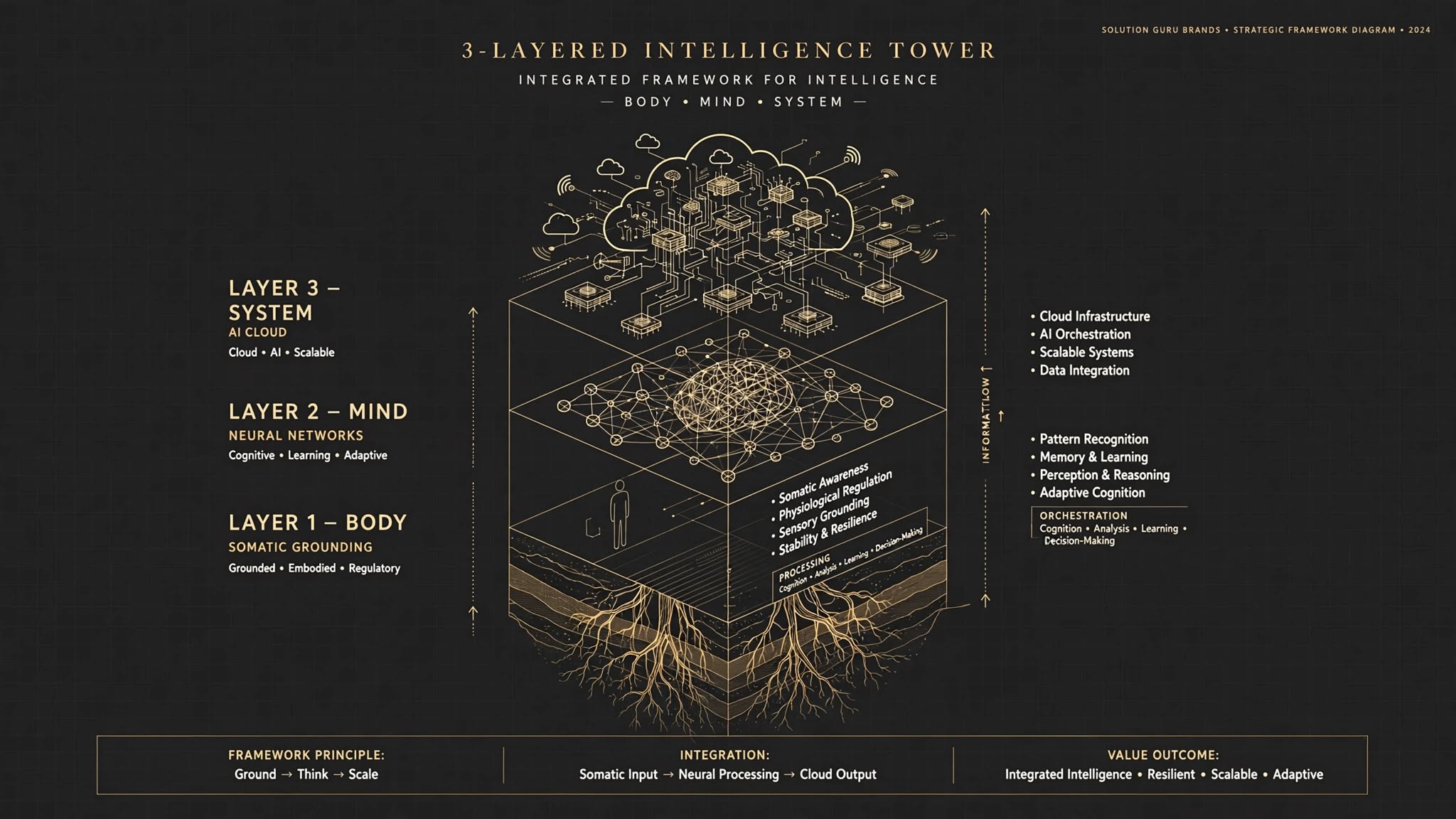
The Strategic Opportunity: Building the Body, Not Collecting the Parts
Here's where execution becomes the differentiator. Most organizations aren't failing at AI because they picked the wrong layer — they're failing because they're stacking layers randomly. An LLM here, a vector store there, an "agent" bolted on top because the demo looked impressive in a boardroom. That's the AI version of random strategy: it produces motion, not a system you can stand behind.
Continuous Strategic Solution Development treats AI adoption the same way it treats any strategic build: as an architecture decision, not a tooling decision. Before a single tool gets selected, three questions have to be answered in sequence.
The Sequencing Framework
Decide what must be known versus what must be retrieved. This is a Strategic Auditing question — what belongs permanently in the model's reasoning, and what must always be pulled fresh from the record?
Decide what must be said versus what must be done. This is where Strategic Blueprinting earns its name — mapping the boundary between an AI system that informs and one that acts.
Only then choose tools, protocols, and autonomy. This is Strategic Implementation — and it comes last, not first, because tool selection without the first two decisions is how integration sprawl gets built into the foundation.
Skip the sequence, and you don't have an architecture. You have a demonstration — and demonstrations don't survive contact with an audit, a client escalation, or a board question about accountability.
The Accountability Test
Before you approve, fund, or deploy any AI initiative in your organization, run it through four questions. This is the diagnostic layer most teams skip — and the layer where Strategic Accountability becomes non-negotiable.
Where does the knowledge live? In the weights, in the documents, or in both?
What is allowed to change the world? Answer only — or action?
How do the tools attach? One-off glue — or a standard connector?
Who is accountable when the hands move? The model, the operator, or the organization that deployed it?
If you cannot answer all four with precision, you don't have an AI strategy. You have exposure wearing the language of innovation.

Practical Application
For the leader building this into their organization, the anatomy translates directly into a build sequence:
Diagnostic stage (Strategic Auditing): Inventory what your team currently expects from AI — and be honest about which expectations are actually brain-only tasks masquerading as system-level capability.
Grounding stage (Strategic Sourcing): Identify the proprietary documents, records, and data sources that must feed the system before a single output is trusted.
Connection stage (Strategic Blueprinting): Map which tools and data sources need standardized connectors — and resist the one-off integration shortcut that always feels faster in the moment and always costs more within two quarters.
Action stage (Strategic Implementation): Define, in writing, exactly what the system is authorized to do versus merely say — and who owns the consequence when it acts.
Governance stage (Strategic Accountability): Run the four-question audit above on a recurring cadence, not as a one-time checkbox.
Recommendation
Don't ask "which AI tool should we buy." Ask "which layer of the body are we missing, and what happens if we act without it." The organizations that will out-position their competitors over the next three years aren't the ones with the flashiest agent demo — they're the ones who can answer the accountability test cold, in front of a client, a board, or a regulator.
If forced to choose a starting point for most small-enterprise leaders: start with the books, not the hands. Grounding your knowledge base through disciplined retrieval is lower-risk, higher-leverage, and builds the foundation that makes a future agent trustworthy instead of reckless. Hands come later. Judgment comes first.
Next Move
Take the four-question Accountability Test to your next internal AI conversation — whether that's a vendor pitch, an internal build, or a client proposal. If any one of the four questions produces a shrug instead of an answer, you've found your next Strategic Audit.
The brain generates language. The books keep it honest. The connectors make it usable. The hands make it consequential.
Build them as one body. Then hold the body to a standard.
Your Solution Guru Shawn Ryan Randleman
#SolutionGuruBrands #ScalingBeyondTheOrdinary #ContinuousStrategicSolutionDevelopment #AIStrategy


